
FAST-DS 2026: Is the ₹1 Lakh Fee Needed to Disclose Foreign Assets?
By CA Mayank Agarwal, Chartered Accountant, Partner In-Charge, Bhopal
A small, forgotten foreign holding can trigger a CBDT notice and a fear of the ₹10 lakh Black Money Act penalty. The FAST-DS 2026 window closes on 31 December 2026, and its fee is a flat ₹1,00,000. Before you pay it, check whether the law already protects you at no cost.
Over the last few months, many Indian residents have received automated CBDT alerts built on FATCA and CRS data. The message is usually the same: you may hold a foreign asset that was not reported in Schedule FA of your income tax return (ITR).
The first reaction is panic. People recall the ₹10,00,000 penalty per assessment year under the Black Money Act, 2015 (BMA). Investors with a ₹500 promotional fractional share from an investment app, leftover ESOP units, or an old US bank account with a small balance start to look at the Foreign Assets of Small Taxpayers – Disclosure Scheme, 2026 (FAST-DS 2026).
My advice is simple. Do not pay the ₹1 lakh fee until you have checked the safe harbour in the Act itself. For many small holders, the law already gives the protection that the scheme sells.
Quick answer: is a fee payable for a voluntary disclosure?
| Your situation | Is the ₹1,00,000 fee needed? |
|---|---|
| Foreign movable assets (shares, ESOPs, bank accounts, funds) with aggregate peak value up to ₹20 lakh, funded from taxed or LRS money | No. The penalty is barred by law. Disclose in Schedule FA from now on. |
| Foreign movable assets above ₹20 lakh, funded from taxed money | Usually yes. FAST-DS 2026 (Category 2) is worth evaluating. |
| Foreign immovable property (flat, land), however small the value | Usually yes. The ₹20 lakh safe harbour does not cover real estate. |
| Foreign assets funded from unexplained or untaxed money | Category 1 applies. The cost is 60% of the value, so take professional advice first. |
1. What is FAST-DS 2026, and who is it for?
FAST-DS 2026 is a one-time, time-limited disclosure window introduced by the Finance Act, 2026. It runs on the income tax e-filing portal from 16 August 2026 to 31 December 2026. It gives individuals who did not disclose foreign assets or foreign income in earlier returns a route to immunity from further tax, penalty and prosecution under the Black Money Act.
The scheme has two tracks.
| Parameter | Category 1: undisclosed or unexplained assets | Category 2: explained source or procedural non-reporting |
|---|---|---|
| Nature of asset | Foreign assets or income whose source cannot be explained, or untaxed foreign income that was chargeable to Indian tax | Assets bought out of income already taxed in India (salary, business income, funds sent under LRS), or income earned while a non-resident (NRI) and left out of Schedule FA after returning to India |
| Eligibility ceiling (value as on 31 March 2026) | Aggregate value up to ₹1 crore | Aggregate value up to ₹5 crore |
| Cost | 60% total outflow (30% tax plus 100% additional levy on that tax) | Flat fee of ₹1,00,000, whether the asset is worth ₹500 or ₹4.5 crore |
| Immunity | Immunity under the BMA on a valid declaration and payment | Immunity under the BMA on a valid declaration and payment |
Who typically needs Category 2
- Tech employees with sizeable RSUs or ESOPs. Professionals at Indian subsidiaries of multinationals who hold vested foreign-parent shares worth more than ₹20 lakh, funded through taxable salary shown in Form 16, and never reported them in Schedule FA.
- Returning NRIs (RNOR to ROR). Persons who came back to India, became Resident and Ordinarily Resident, and kept overseas deposits, mutual funds or pensions without reporting them.
- High-value LRS investors. Residents who legitimately remitted funds under the Liberalised Remittance Scheme to buy foreign shares, ETFs or property, but skipped Schedule FA.
2. The statutory shield: the ₹20 lakh safe harbour
Does everyone with an unreported foreign asset have to opt for FAST-DS 2026? No.
Sections 42 and 43 of the BMA allowed a flat ₹10,00,000 penalty for each assessment year. The Finance (No. 2) Act, 2024, with effect from 1 October 2024, changed the provisos to both sections. In substance, they now say:
The section shall not apply to an asset or assets, other than immovable property, where the aggregate value does not exceed twenty lakh rupees.
What this means in practice
- A universal ₹20 lakh limit. The older ₹5 lakh limit, which covered only certain foreign bank accounts, became a ₹20 lakh limit across all non-immovable foreign assets.
- Movable assets are covered. Foreign listed equity, fractional shares, mutual funds, custodial accounts, ESOPs and deposit balances all qualify.
- The bar is absolute. If the aggregate value of all your foreign movable assets did not exceed ₹20 lakh at any point in the relevant financial year, the penalty under Section 42 or 43 cannot be levied.
3. Prosecution: Sections 49 and 50
Small holders also worry that a technical omission can lead to a criminal case under Section 49 or Section 50.
The CBDT has aligned its internal guidelines with the 2024 amendment. Its instruction of 18 August 2025 directs field officers that no prosecution under Section 49 or 50 is to be started where the asset falls inside the ₹20 lakh safe harbour and no penalty under Section 42 or 43 can be levied.
4. The ₹1 lakh trap: FAST-DS 2026 versus regular law
The Category 2 fee does not scale down for small holdings. Paying ₹1,00,000 to cure the omission of a ₹500 or ₹50,000 holding means paying many times the value of the asset for immunity that the statute already gives you.
| Parameter | Route A: FAST-DS 2026 | Route B: statutory safe harbour (BMA provisos) |
|---|---|---|
| Out-of-pocket cost | Flat ₹1,00,000 fee | ₹0 penalty, as the law bars it under Sections 42 and 43 |
| Section 43 penalty risk | Removed through the immunity certificate in Form 4 | Removed directly by statute up to ₹20 lakh |
| Prosecution risk | Removed through scheme immunity | Barred by the CBDT instruction of 18 August 2025 |
| Procedure | File Form 1, receive the order in Form 2, pay, file Form 3 (payment intimation), receive the certificate in Form 4 | Disclose in your ITR going forward, or file ITR-U under Section 139(8A) for past years |
| Economic sense | Poor for assets under ₹20 lakh | Sound and cost-effective |
5. Three practical illustrations
Illustration 1: the app-based fractional share (₹500 holding)
Facts. A salaried resident opened an account on an Indian fintech platform that offers US stocks in FY 2023-24. On signup, the platform gifted a ₹500 fractional share of a US-listed company. The individual filed ITR-1 for AY 2024-25 and AY 2025-26 and left Schedule FA out.
Analysis
- The asset is a movable equity holding.
- The aggregate value of ₹500 is far below the ₹20,00,000 limit.
- A Section 43 penalty cannot be levied.
- Prosecution under Sections 49 and 50 is barred by the CBDT guidelines.
Recommended action. Do not file under FAST-DS 2026. Report the holding in Schedule FA in the current return and every return after it. If a small amount of foreign dividend was missed, correct it through an updated return (ITR-U) under Section 139(8A) and pay the regular tax.
Illustration 2: tech professional with ₹14 lakh in vested RSUs
Facts. A software engineer holds vested RSUs worth ₹11,00,000 in an overseas parent company and a US payroll savings account with ₹3,00,000. Both came from Indian salary taxed in Form 16. Schedule FA was blank in earlier returns.
| Asset | Peak value |
|---|---|
| Vested RSUs | ₹11,00,000 |
| US payroll savings account | ₹3,00,000 |
| Aggregate | ₹14,00,000 |
The aggregate is below ₹20 lakh, so the Section 43 penalty cannot be levied.
Recommended action. Avoid paying ₹1,00,000 under FAST-DS 2026. File ITR-U under Section 139(8A) with Schedule FA for the open assessment years. Pay the regular tax, plus the additional tax on any untaxed foreign dividend (25% of tax and interest if filed within 12 months of the end of the assessment year, 50% within 24 months, 60% within 36 months and 70% within 48 months), and stay compliant in future returns.
Illustration 3: foreign immovable property (the critical exception)
Facts. A resident bought a studio apartment in Dubai for ₹18,00,000 in FY 2023-24 through proper LRS banking channels, and did not disclose it in Schedule FA.
Analysis
- The provisos to Sections 42 and 43 apply only to assets other than immovable property.
- The ₹20 lakh safe harbour does not apply to real estate, however low the value.
- The full ₹10,00,000 penalty for each assessment year remains chargeable.
Recommended action. The source of funds is fully explained through banking channels. Opting for FAST-DS 2026 under Category 2 and paying the ₹1,00,000 fee is a rational hedge against a recurring ₹10 lakh penalty for every year of omission.
6. Critical caveats
- No penalty does not mean no reporting. The ₹20 lakh limit stops the penalty. It does not remove the duty to file Schedule FA. A Resident and Ordinarily Resident (ROR) individual with foreign assets must continue to report them in Schedule FA.
- The limit is an aggregate. The ₹20 lakh ceiling applies to the combined peak value of all foreign movable assets (shares, bank deposits, mutual funds, life insurance policies) during the financial year, not to each asset separately.
- Untaxed money is a different problem. If the foreign assets were bought from unaccounted or untaxed funds, the main charges still apply: tax at 30% and a penalty of 90%. The safe harbour shields only the procedural penalties under Sections 42 and 43.
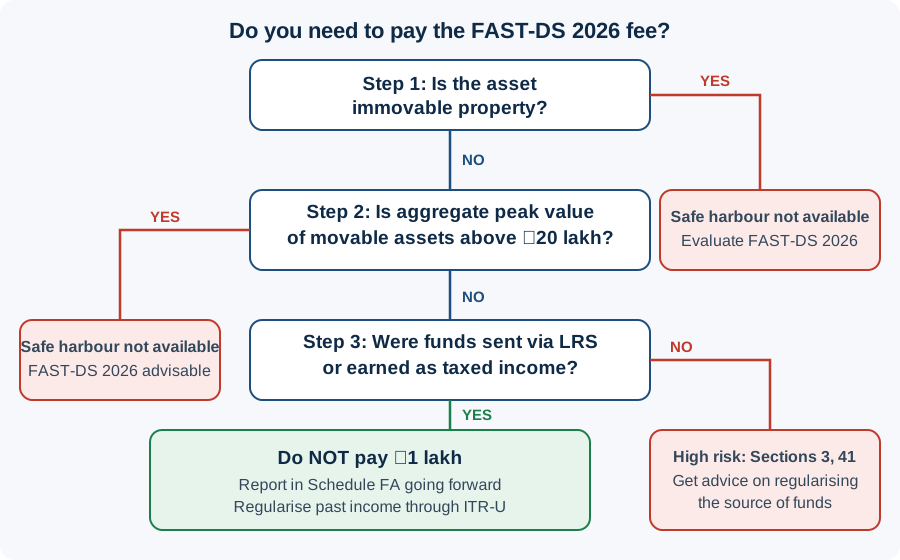
Decision checklist: should you pay the scheme fee?
| Step | Question | If yes | If no |
|---|---|---|---|
| 1 | Is the foreign asset immovable property? | The safe harbour does not apply. Evaluate FAST-DS 2026 (flat ₹1 lakh). | Go to Step 2. |
| 2 | Is the aggregate peak value of all foreign movable assets above ₹20 lakh in the year? | The safe harbour does not apply. FAST-DS 2026 is advisable. | The safe harbour applies. Go to Step 3. |
| 3 | Were the funds sent under LRS, or earned as taxed salary or income? | Do not pay ₹1 lakh. Report in Schedule FA going forward and regularise past income through ITR-U. | High risk: tax at 30% and penalty of 90% can apply. Get advice on regularising the source of funds. |
The deadline is 31 December 2026
The FAST-DS 2026 window closes on 31 December 2026, so Form 1 must be filed on or before that date. If your case sits near the edge (assets close to ₹20 lakh, a mix of movable and immovable assets, or a source of funds that is hard to document), decide well before the end of December. Gathering valuations, bank statements and remittance records takes time.
Frequently asked questions
Is a fee payable for a voluntary disclosure of foreign assets? Under FAST-DS 2026, Category 2 carries a flat fee of ₹1,00,000. Category 1 costs 60% of the value. No fee applies if you rely on the statutory safe harbour, because there is no scheme to enter.
I hold a foreign share worth ₹500. Should I file under FAST-DS 2026? Usually not. It sits well inside the ₹20 lakh safe harbour. Report it in Schedule FA from now on and correct past returns through ITR-U if any income was missed.
Does the ₹20 lakh limit cover a flat or plot abroad? No. Immovable property is excluded from the safe harbour. Evaluate FAST-DS 2026.
What happens if I do nothing and my assets are under ₹20 lakh? The ₹10 lakh penalty and prosecution are not available to the department for such assets. You should still file Schedule FA going forward, since the reporting duty continues.
Does the safe harbour protect foreign assets bought from undisclosed money? No. It covers only the reporting penalties under Sections 42 and 43. Tax and penalty on unexplained sources can still apply.
What is the last date to file under FAST-DS 2026? 31 December 2026, through Form 1 on the e-filing portal.
Conclusion
For a ₹500 holding bought through legitimate channels, paying ₹1,00,000 for an amnesty is poor value. The Finance (No. 2) Act, 2024 and the CBDT instruction of 18 August 2025 already protect against both penalty and prosecution. The right approach is to regularise the position in Schedule FA, in the current return and every return that follows.
FAST-DS 2026 earns its fee where the safe harbour does not reach: foreign property, or movable assets above ₹20 lakh. With the window closing on 31 December 2026, the time to take that decision is now, with a clear view of your asset values and your source of funds.
Disclaimer: This article is the personal opinion of CA Mayank Agarwal, based on the Black Money Act, 2015, the Finance (No. 2) Act, 2024, the Finance Act, 2026 and the FAST-DS 2026 rules as understood at the time of writing. It is general information, not advice on any particular case. The right course of action depends on the facts of each case, including the type and value of the asset, the source of funds and the years involved, and the final position may differ from the views expressed here. Speak to your chartered accountant before you file under FAST-DS 2026 or choose not to.